The steam rises before you see the water. On the trail through the Waimangu Volcanic Valley, sulfur sharpens the air and the ground feels faintly warm beneath your boots. Frying Pan Lake, one of the largest hot springs on the planet, sits in a crater that did not exist before 1886. The entire rift valley you are walking through — ferns unfurling from ash, mineral-stained rock still hissing with geothermal heat — was created in a single night, when Mount Tarawera erupted and buried villages in the dark.
This is what New Zealand does to you: it makes geological time feel personal.
In twelve days, a walking tour here crosses ocean floors lifted into limestone battlements, volcanic cones you can peer into, rainforests so thick with ferns they look Jurassic, and fiords carved by glaciers that have mostly retreated within a lifetime. The two islands stretch longer than California but hold just over five million people. Much of what you walk through feels genuinely wild — not preserved wild, but wild because no one has figured out how to build there.
What It's Like to Walk Here
The trails range from paved urban routes to backcountry tracks where tree roots serve as stairs and mud is a given. In Auckland, the Coast-to-Coast walk crosses the isthmus between two oceans, climbing volcanic cones that Māori once fortified with hand-carved terracing — you can still see the ridgeline scars of those ancient pā on One Tree Hill. South of the city, the Te Waihou Walkway follows a spring-fed stream so clear it barely looks like water; the Blue Spring here takes fifty to a hundred years to filter through volcanic rock before surfacing, and the colour of it stops people mid-stride.
The walks are designed for active adults, not mountaineers. Distances run three to twelve kilometres. Two WAI guides walk every trail — one in front setting the pace, one in back making sure nobody gets left behind on slippery cave steps or muddy descents. On tougher days there is almost always an Option B: a shorter route, a gentler grade, a chance to sit beside a lake and let the group catch up.
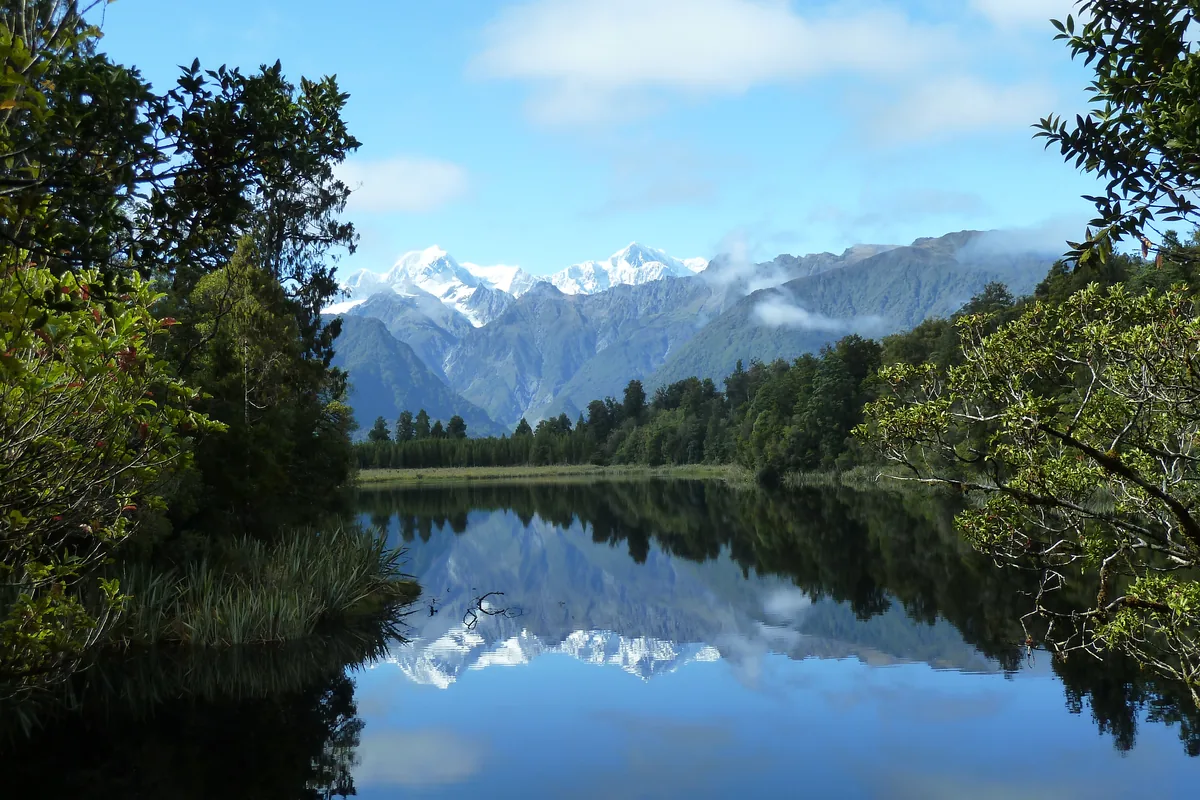
On a still morning, Lake Matheson holds the Southern Alps twice over.
Fire, Ice, and Everything Between
New Zealand broke away from Gondwana roughly 80 million years ago. Because it drifted alone in the South Pacific, no land mammals arrived except bats. Birds filled every ecological niche — some, like the kiwi and the now-extinct moa, grew large and flightless, because there was nothing on the ground to flee from. At Sanctuary Mountain Maungatautari, ringed by one of the longest predator-proof fences in the world, you walk through bush that approximates pre-human New Zealand, where species once thought lost forage in the undergrowth.
The South Island tells a different story. The Alpine Fault forces the Pacific Plate upward, raising the Southern Alps about seven millimetres a year — which sounds like nothing until you stand at Fox Glacier and learn that paths touching the ice in the early 2000s now end far from it. The retreat is visible within a single generation. Most of what you see in New Zealand is, in geological terms, temporary.
Māori cosmology understands that impermanence differently. Mountains are not scenery — they are ancestors; rivers are descendants. At the evening hāngī in Rotorua, food is cooked underground over heated stones. The pōwhiri welcome ceremony tests whether you come in peace; the hongi, pressing noses, shares the breath of life. These are not performances. They are protocols.
Just seeing it all and having it explained in the most interesting ways. I loved the history of the Māori, the land formation, the flora and fauna, the spots where Lord of the Rings was filmed, the friendship of the other travelers, the expert care of our WAI guides.
Sandra, New Zealand traveler
Why We Go Here
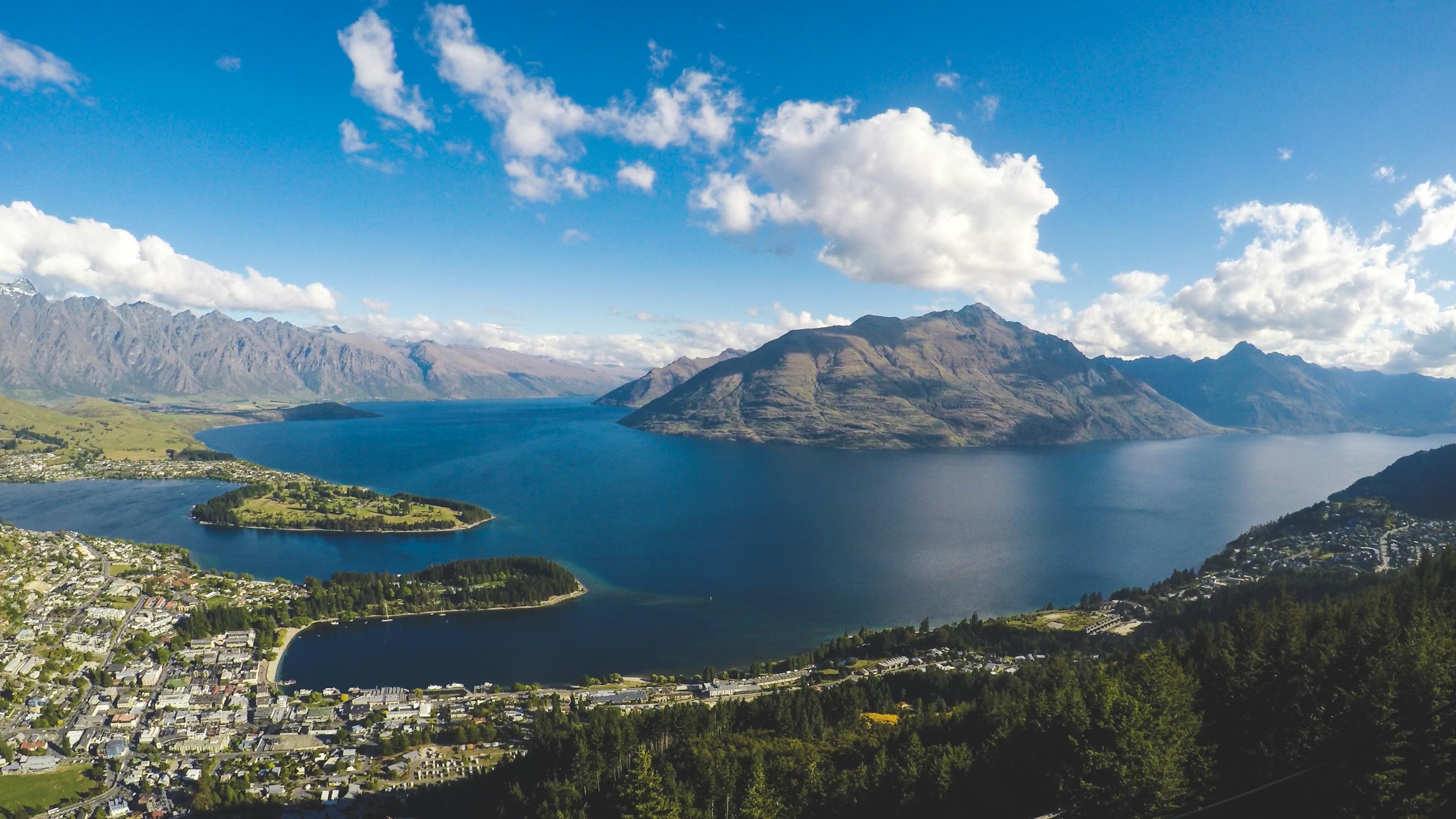
Doubtful Sound is the reason. Three times longer than Milford and ten times its surface area, it is also far less visited. Captain Cook gave it the name in 1770 because he doubted he could sail back out. Our itinerary includes an overnight aboard the Fiordland Navigator, cruising the full length of the fiord toward the Tasman Sea. Cliffs rise more than 1,200 metres straight from the water. Waterfalls keep falling long after dark, and morning arrives with birdsong drifting across water so still it mirrors the cliffs, miles from the nearest road.
The itinerary moves deliberately from north to south, urban to wild, volcanic to glacial — building a geological story day by day. Two WAI guides walk every trail, and a local New Zealand specialist rides the coach between walks, teaching Māori words, pointing out Lord of the Rings filming locations, and telling the stories that make the landscape feel lived-in rather than looked-at.
What Travelers Say
I really appreciate the way there is one guide at the front and one guide at the back. It makes me feel very safe and like I can't get lost.
Julie
I love New Zealand — the land, culture, birds, everything.
Nancy